Measurement Sensors
Measurement Sensors for the LED Lighting Industry
The LED industry has entered a stage in which 0603 LEDs are considered giant, despite the fact they’re only 1.6 mm × 0.8 mm in size. LEDs have become so small that their components are 10x to 100x smaller than previous models.
Measurement sensors are vital in the LED industry. They ensure accurate monitoring and control of several parameters during production and testing. These sensors assess factors like brightness, colour temperature, and energy efficiency, enabling manufacturers to maintain high-quality standards.
Manufacturing these new LEDs requires extreme miniaturisation. Traditional measurement methods are becoming less viable, as many can’t accurately measure such small components. As a result, manufacturers are turning towards non-contact measurement sensors — such as laser profilers and laser displacement sensors — as precise, non-invasive replacements.
Choose Case of Measurement Sensors for the LED Lighting Industry
Chip Mounter Z-Axis Control (LED)
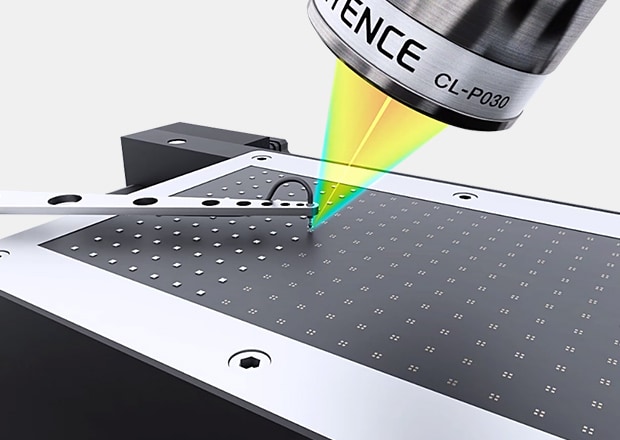
Distance to the PCB on which the chip is to be mounted will be measured to control mounting height.
The CL-3000 Series uses a multi-colour confocal measurement principle, which enables high-precision measurement of large areas. The spot diameter stays the same throughout the entire range, enabling high accuracy even if the distance to the target changes.
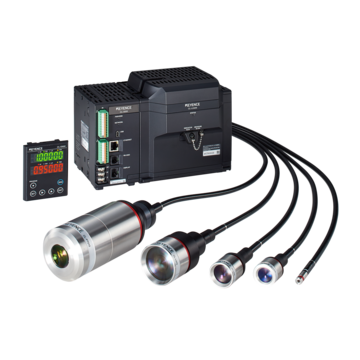
Confocal Displacement Sensor CL-3000 series
Chip Tilt Inspection (LED)
The PCB surface is scanned with the LJ-X8000 Series to measure the height of mounted LED chips. The measured in-plane height data can be used to inspect not only chip mounting height, but tilt as well.
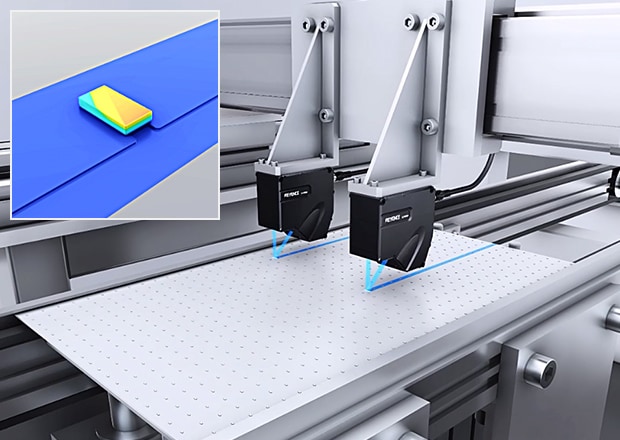
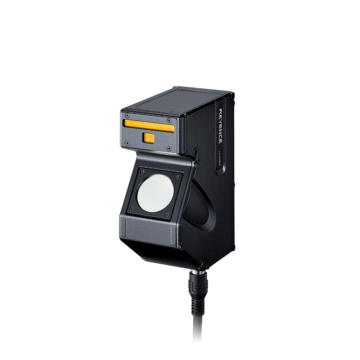
2D/3D Laser Profiler LJ-X8000 series
The Role of Laser Snapshot Sensors in the LED Industry
The LED industry depends so much on accuracy and efficiency, especially during manufacturing and quality control processes. 3D laser snapshot sensors are becoming increasingly important in the LED industry due to their ability to provide fast, accurate, and precise measurements of LED components. These sensors capture explicit, high-resolution 3D images ensuring even the smallest defects are identified without slowing down production. Snapshot sensors are especially effective in recognising problems that are challenging to spot, such as irregularities in LED placement and surface flaws, which, if undetected, can impact the quality and performance of LED products.
How 3D Snapshot Sensors Improve LED Industry Applications
3D snapshot sensors for LED industry applications are crucial. By using these sensors, manufacturers gain access to real-time, three-dimensional data that improves their inspection potential and promotes product consistency. Unlike early formal 2D sensors, 3D snapshot sensors deliver depth information, which is critical for assessing the geometry, spacing, and alignment of LED components. This technology enables manufacturers to distinguish and rectify defects more efficiently, reducing waste and ensuring consistent, high-quality LED output.
How Industrial Snapshot Sensors Enhance LED System Inspections
In industrial LED system applications, snapshot sensors are needed for demanding quality checks. These industrial sensors can scan complex LED assemblies faster and accurately, providing a constructive solution for inspecting a wide range of LED products. Industrial snapshot sensors improve LED system inspections by providing precise measurement data that ensures every component meets strict quality standards. With the ability to inspect multiple aspects of LEDs at once, these sensors streamline quality assurance processes, ultimately enhancing the reliability of LED systems.
Compatibility with Different LED Types and Configurations
The LED industry encompasses a wide range of LED types and packages, each with its own specific use case and performance criteria. The importance of precise LED measurements in this industry is further underscored by the introduction of high-definition screen displays based on mini- and micro-LED technologies, which rely on sub-mm packaging and configurations.
LED sensors offer exceptionally high precision, often measured in the single-digit µm range, making these sensors highly versatile and capable of scanning various LED types and configurations. Furthermore, their high precision offers increased adaptability to even smaller packages, which is crucial for reliable implementations in an industry where miniaturisation is one of the key drivers of success.
Manufacturers can now use a single LED sensor type to measure different LED productions ranging from micro-LEDs present in screen displays to small indicator lights and large lighting panels.
Laser Measurement Tools
Laser measurement sensors for the LED Lighting industry bring a whole new level of precision, speed, and versatility perfectly suited for the ongoing miniaturisation of electronic components. LED sensors are great at providing highly accurate 2D and 3D measurements, ensuring that the products meet strict quality standards.
Optimise Your LED Analysis with Precision Measurement Using KEYENCE LJ-S8000 Series Sensors
KEYENCE LJ-S8000 Series sensors exemplify the precision and efficiency demanded by the LED industry. These 3D laser snapshot sensors for the LED industry offer a wide variety of inspection capabilities, including dimensioning, appearance, and shape detection. By utilising motor-driven scanning technology, the LJ-S8000 Series can achieve ultra high-speed and ultra high-accuracy inline inspections with imaging speeds as fast as 0.2 seconds. It also provides differentiation capabilities without the need for external lighting or complex setups.
By providing detailed surface profiles and rapid data acquisition, LJ-S sensors support manufacturers in achieving greater quality assurance, minimising defects, and optimising LED performance.
As the LED industry continues to grow and the technology continues to evolve, the role of LED sensors and LED measurement systems in precise measurements will become even more pronounced.
If you’re looking to implement laser measurement and LED sensors into your existing manufacturing process, don’t hesitate to contact KEYENCE and inquire with our team about possible integrations with your current system.